

What is a straight in poker?
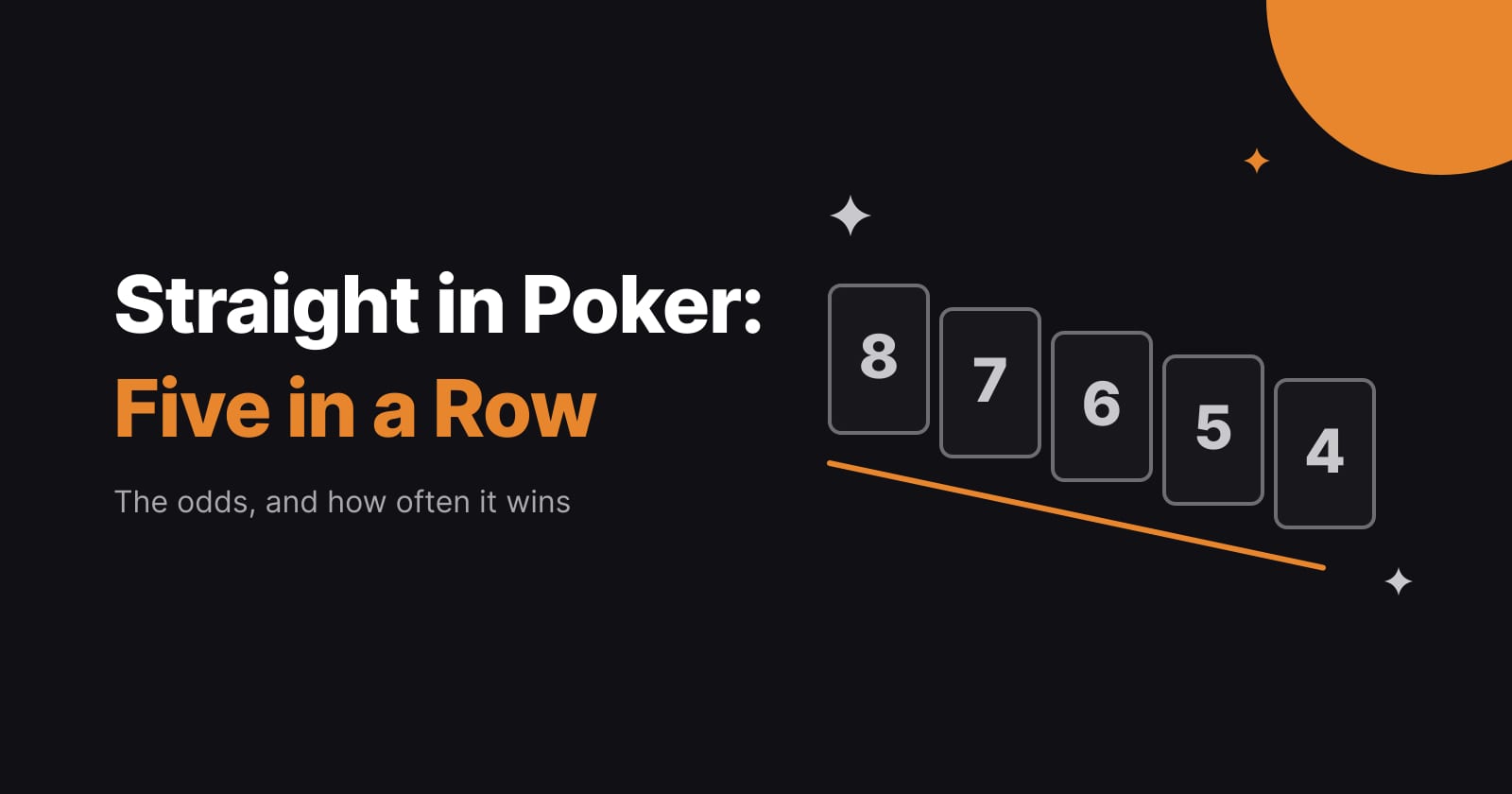
A straight in poker is five cards in consecutive rank order, in any mix of suits: eight-seven-six-five-four is a straight. It ranks sixth of the ten hands. It beats three of a kind, two pair and one pair, and it loses to a flush, a full house, four of a kind and a straight flush. Our hand rankings chart has the full order.
Can the ace be high and low in a straight?
Yes, but not both at once. This part is standard rules, not our data. The ace is high in ten-jack-queen-king-ace, called Broadway, the best straight. It is low in ace-two-three-four-five, called the wheel, the worst. A straight cannot wrap around, so queen-king-ace-two-three is nothing. That leaves ten possible straights. Between two straights the higher top card wins, so three-four-five-six-seven beats the wheel even though the wheel holds an ace. Two players with the same straight split the pot.
What are the odds of making a straight?
This part is exact arithmetic, not our data. Five cards dealt at once make a straight 0.39% of the time, 1 in 255: there are 10,200 straights among 2,598,960 hands. With seven cards to choose from, a Texas Hold’em hand ends with a straight about 4.6% of the time.
Most straights start as draws. An open-ended draw on the flop, four in a row with eight outs, gets there 31.5% of the time by the river. A gutshot, with four outs, gets there 16.5%. The poker odds guide lists every other draw.
Which starting hands make the most straights?
Connected cards in the middle of the deck. We counted every one of the 2,118,760 possible boards for each hand, offsuit, and how often its best hand at the river is a straight:
| Starting hand, offsuit | Flops a straight | Straight by the river |
|---|---|---|
| Jack-ten | 1.31% | 9.18% |
| Eight-seven | 1.31% | 9.08% |
| Ten-eight, one gap | 0.98% | 7.80% |
| Nine-six, two gaps | 0.65% | 6.42% |
| King-queen | 0.65% | 5.01% |
| Ace-five | 0.33% | 4.43% |
| Ace-king | 0.33% | 3.30% |
| Seven-two | never | 2.67% |
| Pocket eights | never | 2.30% |
By PlusEV’s exact count over all 2,118,760 boards, jack-ten offsuit ends with a straight 9.18% of the time, twice the 4.6% average, and ace-king only 3.30%. Every gap between your cards costs about 1.4 points. Cards near the ace lose straights too, because nothing connects above an ace: king-queen has two ways to make a straight with both cards, and jack-ten has four.
How often does a straight win?
About four times in five against one random hand, and it splits the pot far more often than a flush does. We dealt 4,000,000 random two-player hands to the river and looked at every straight:
| Hole cards the straight uses | Share of straights | Wins | Ties | Loses |
|---|---|---|---|---|
| Both | 39.6% | 94.3% | 0.9% | 4.8% |
| One | 53.4% | 81.2% | 11.4% | 7.4% |
| None, a straight on the board | 7.0% | 0% | 82.4% | 17.6% |
| Every straight | 100% | 80.7% | 12.2% | 7.1% |
In PlusEV’s simulation of 4,000,000 two-player deals, a straight won the showdown 80.7% of the time and split the pot 12.2%. Of the straights that lost, 52.5% were beaten by a higher straight, 35.1% by a flush and 10.7% by a full house.
A straight made with both hole cards is rarely shared: it tied 0.9% of the time. One made with a single card on a four-in-a-row board is the hand that gets split or beaten.
How do solver ranges treat connected hands?
They play fewer of them with every gap. We grouped the suited hands with a jack or lower as the high card by the gap between the two ranks, and counted how much of each group PlusEV’s 6-max solver ranges open:
| Suited hands, jack-high or lower | Under the gun | Cutoff | Button |
|---|---|---|---|
| Connectors, jack-ten to three-two | 36.4% | 74.2% | 77.8% |
| One gap, jack-nine to four-two | 14.0% | 46.4% | 62.5% |
| Two gaps, jack-eight to five-two | none | 28.6% | 42.9% |
| Three gaps, jack-seven to six-two | none | none | 33.3% |
In PlusEV’s 6-max solver ranges, the button opens 77.8% of suited connectors, 62.5% of one-gap suited hands and 33.3% of three-gap ones. The offsuit connectors from jack-ten to three-two are opened 22.2% of the time there, and never under the gun. Our suited connectors guide covers how these hands play against raises.
| AA | AKs | AQs | AJs | ATs | A9s | A8s | A7s | A6s | A5s | A4s | A3s | A2s |
| AKo | KK | KQs | KJs | KTs | K9s | K8s | K7s | K6s | K5s | K4s | K3s | K2s |
| AQo | KQo | QJs | QTs | Q9s | Q8s | Q7s | Q6s | Q5s | Q4s | Q3s | Q2s | |
| AJo | KJo | QJo | JJ | JTs | J9s | J8s | J7s | J6s | J5s | J4s | J3s | J2s |
| ATo | KTo | QTo | JTo | TT | T9s | T8s | T7s | T6s | T5s | T4s | T3s | T2s |
| A9o | K9o | Q9o | J9o | T9o | 99 | 98s | 97s | 96s | 95s | 94s | 93s | 92s |
| A8o | K8o | Q8o | J8o | T8o | 98o | 88 | 87s | 86s | 85s | 84s | 83s | 82s |
| A7o | K7o | Q7o | J7o | T7o | 97o | 87o | 77 | 76s | 75s | 74s | 73s | 72s |
| A6o | K6o | Q6o | J6o | T6o | 96o | 86o | 76o | 66 | 65s | 64s | 63s | 62s |
| A5o | K5o | Q5o | J5o | T5o | 95o | 85o | 75o | 65o | 55 | 54s | 53s | 52s |
| A4o | K4o | Q4o | J4o | T4o | 94o | 84o | 74o | 64o | 54o | 44 | 43s | 42s |
| A3o | K3o | Q3o | J3o | T3o | 93o | 83o | 73o | 63o | 53o | 43o | 33 | 32s |
| A2o | K2o | Q2o | J2o | T2o | 92o | 82o | 72o | 62o | 52o | 42o | 32o | 22 |
How should you play a straight?
This part is standard theory:
- Bet it. A straight beats every pair, two pair and set.
- Beware the low end. Holding the bottom card of a four-in-a-row board loses to anyone with the card above it.
- Watch for three of a suit or a pair on the board. Those are the boards where a flush or a full house is possible.
- Expect to split when the board does the work. A one-card straight is often shared.
A straight in poker is five cards in a row: a 4.6% hand on average, 9% with the right connected cards, and a winner four times in five. The PlusEV preflop trainer drills which connected hands to open from each seat, so you play the ones that make the best straights.
Quick answers
What is a straight in poker?
Five cards in consecutive rank order, such as eight-seven-six-five-four, in any mix of suits. If all five share a suit it is a straight flush.
What beats a straight in poker?
A flush, a full house, four of a kind and a straight flush. A straight beats three of a kind, two pair, one pair and high card.
Does ace-two-three-four-five count as a straight?
Yes. It is called the wheel, and it is the lowest straight, because the ace plays as a one. Any six-high straight beats it.
Can a straight go around the corner, like king-ace-two?
No. The ace can be high in ten-jack-queen-king-ace or low in ace-two-three-four-five, but queen-king-ace-two-three is not a straight.
Who wins if two players both have a straight?
The straight with the higher top card. If both have the same straight, they split the pot. Suits do not matter.
What are the odds of getting a straight?
In five cards, 1 in 255. A Texas Hold'em hand ends with a straight about 4.6% of the time by the river, and connected cards such as jack-ten about 9%.