

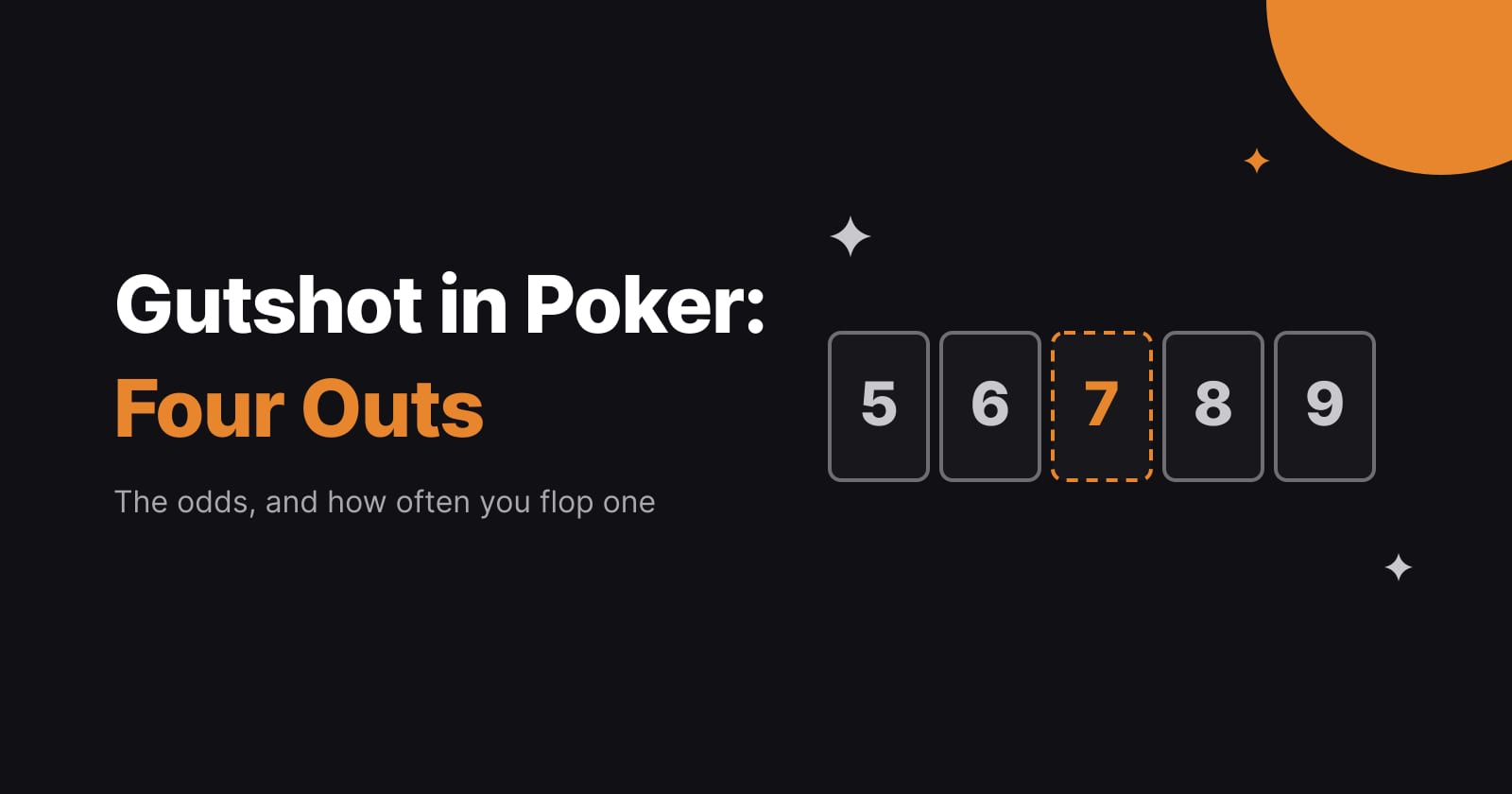
What is a gutshot in poker?
A gutshot in poker is a straight draw that needs one exact rank to fill a gap in the middle. You hold eight-seven and the flop comes ten-six-two: only a nine makes your straight. There are four nines in the deck, so a gutshot has four outs.
Players also call it an inside straight draw or a belly buster. The other kind of straight draw is open-ended: four cards in a row, such as nine-eight on a ten-seven-two flop, where a jack or a six completes it. That draw has eight outs, twice as many. Our hand rankings chart shows where the straight sits once you make it.
What are the odds of hitting a gutshot?
About 11 to 1 against on each card. This part is exact arithmetic, not our data: with your two cards and the flop seen, 47 cards are unseen before the turn and 46 before the river.
| Draw | Outs | Hits on the turn | Hits on the river | Hits by the river |
|---|---|---|---|---|
| Gutshot | 4 | 8.5% | 8.7% | 16.5% |
| Open-ended straight draw | 8 | 17.0% | 17.4% | 31.5% |
| Double gutshot | 8 | 17.0% | 17.4% | 31.5% |
The quick rule is to multiply your outs by two for one card and by four for two cards, which gives 8% and 16% for a gutshot. Our poker odds guide has the same numbers for every other draw.
How often do you flop a gutshot?
More often than any other straight draw. We counted every one of the 19,600 possible flops for each starting hand. Suits do not matter for a straight draw, so the figures hold suited or offsuit:
| Starting hand | Flops a gutshot | Flops an eight-out straight draw | Flops a straight |
|---|---|---|---|
| Connectors, jack-ten to five-four | 16.8% | 9.7% | 1.31% |
| Ten-eight, one gap | 14.8% | 7.7% | 0.98% |
| Nine-six, two gaps | 14.0% | 5.0% | 0.65% |
| King-queen | 12.7% | 3.0% | 0.65% |
| Ace-king | 11.3% | none | 0.33% |
| Pocket eights | 3.9% | 1.3% | none |
| Every starting hand, averaged | 9.9% | 3.3% | 0.39% |
By PlusEV’s exact count over all 19,600 flops, a connector such as jack-ten or eight-seven flops a gutshot 16.8% of the time, about one flop in six, and an eight-out straight draw 9.7%. Averaged over every starting hand, a gutshot comes on 9.9% of flops, three times as often as the eight-out draw.
The more gaps between your cards, the fewer good draws you flop. That is one reason solver ranges prefer connected hands, as our suited connectors guide shows. Ace-king can only ever flop a gutshot, on boards such as queen-jack-four.
What is a double gutshot?
Two gutshots in one hand. You hold nine-seven on a jack-eight-five flop: a ten makes seven-eight-nine-ten-jack, and a six makes five-six-seven-eight-nine. Two ranks complete a straight, so you have eight outs, the same as an open-ended draw. It is also called a double belly buster, and opponents see it coming less often because the board does not show four in a row.
How much equity does a gutshot have?
About 20% against top pair when it is all you have, and far more when something comes with it. We ran each draw on the flop against top pair with an ace kicker, over all 990 possible turn and river cards:
| Your draw | Example | Equity against top pair |
|---|---|---|
| Gutshot only | 8-7 on T-6-2 | 20.3% |
| Gutshot and one overcard | K-J on Q-9-2 | 27.8% |
| Open-ended straight draw | 9-8 on T-7-2 | 34.2% |
| Double gutshot | 9-7 on J-8-5 | 34.2% |
| Gutshot and two overcards | Q-J on T-8-2 | 38.1% |
| Gutshot and a flush draw | 8-7 suited on T-6-2 with two of the suit | 48.3% |
In PlusEV’s exact count, a bare gutshot has 20.3% equity against top pair on the flop, and a gutshot with a flush draw has 48.3%, close to an even-money hand. A gutshot with two overcards is worth more than an open-ended draw, because six more cards give it the best pair.
Should you call with a gutshot?
Not on the price alone. This part is standard math. With one card to come a gutshot hits 8.7% of the time, so a call needs about 10.5 to 1. A half-pot bet offers 3 to 1 and a pot-sized bet 2 to 1, as our pot odds guide explains. The gap has to come from money you win later. Facing a half-pot bet on the turn, a gutshot needs to win another 375 for every 100 in the pot before the bet, as our implied odds guide works out. That only happens with deep stacks and an opponent who pays off.
How should you play a gutshot?
This part is standard theory:
- Fold a bare gutshot to a big bet. Four outs do not pay for a half-pot call unless the stacks are deep.
- Continue when the gutshot comes with more. Overcards, a flush draw or a backdoor flush draw add outs, and the table above shows how fast the equity climbs.
- Use gutshots as bluffs. A gutshot is a good hand to bet or raise with: it wins when the opponent folds, and it still has four outs to a hidden straight when they call.
- Draw to the best straight. A gutshot to the low end of a straight can make your hand and still lose.
A gutshot in poker is a four-out straight draw: 8.5% to hit on the next card, 16.5% by the river, and on about one flop in ten for an average hand. The PlusEV preflop trainer drills which connected hands to play from each seat, so the draws you flop are the ones worth having.
Quick answers
What is a gutshot in poker?
A straight draw that needs one exact rank in the middle. Holding eight-seven on a ten-six-two flop, only a nine makes the straight, so you have four outs.
What are the odds of hitting a gutshot?
About 8.5% on the turn and 8.7% on the river, or 16.5% by the river if you see both cards. That is roughly 11 to 1 against on each card.
What is an inside straight?
The same thing as a gutshot: a straight draw missing one card inside the run. The old advice never to draw to an inside straight is about its long odds.
What is a double gutshot?
Two gutshots at once: two different ranks each complete a straight, for eight outs. It hits as often as an open-ended straight draw, 31.5% by the river, and is harder to spot.
Is a gutshot better than an open-ended straight draw?
No. An open-ended draw has eight outs and hits 31.5% of the time by the river. A gutshot has four outs and hits 16.5%, about half as often.
Should you call a bet with a gutshot?
Only at a good price or with more going for the hand. With one card to come you need about 10.5 to 1, and a half-pot bet offers 3 to 1. Overcards, a flush draw or a deep stack behind can make up the gap.