

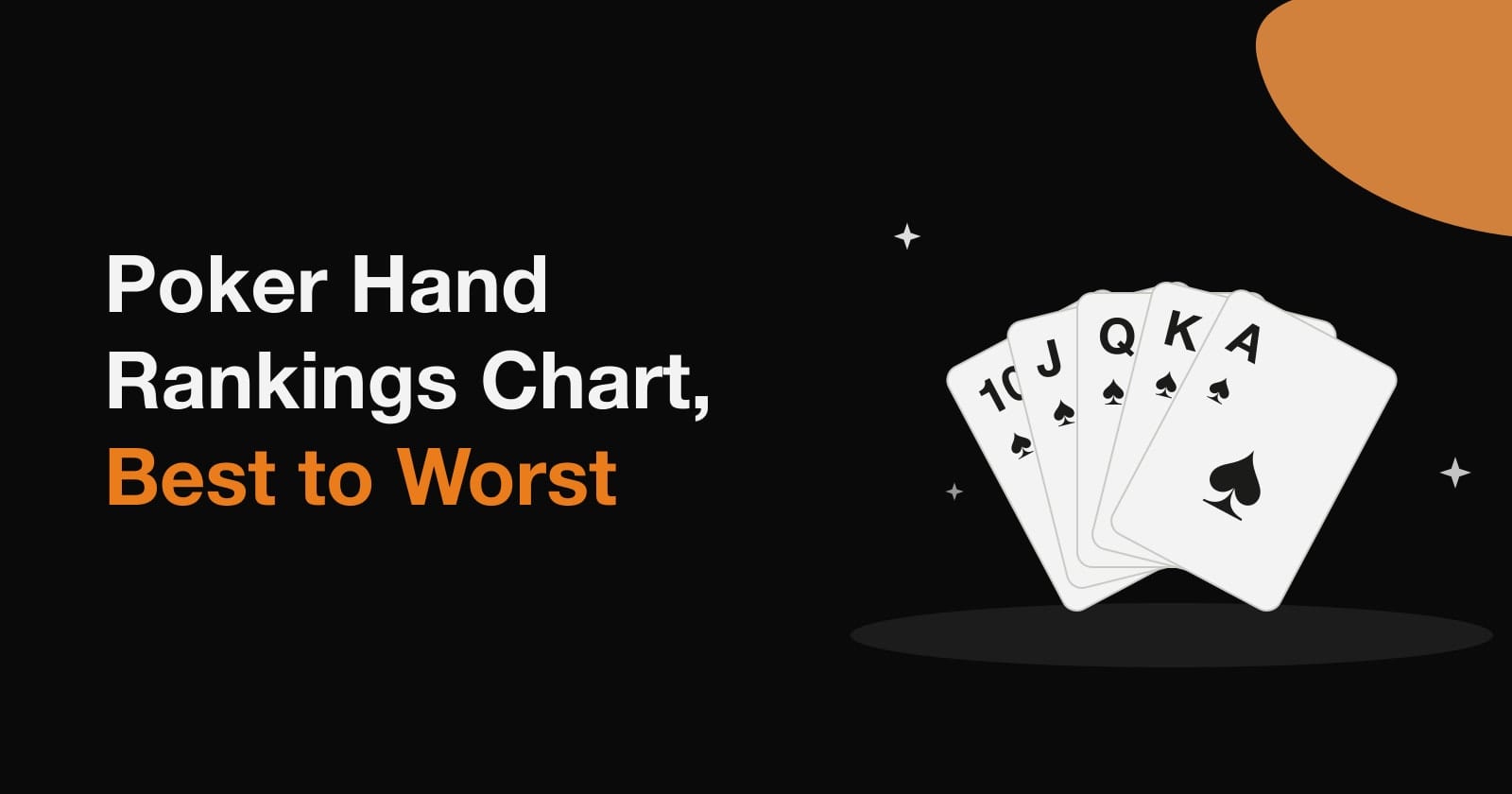
The chart: all ten hands in order
The poker hand rankings, also called hand ratings or hand standings, are the same ten-hand hierarchy in every form of standard poker, Texas Hold’em included. From best to worst: royal flush, straight flush, four of a kind, full house, flush, straight, three of a kind, two pair, one pair, high card. Each beats everything below it. A printable version is on our poker cheat sheet.
| # | Hand | Example | What it is |
|---|---|---|---|
| 1 | Royal flush | A♠K♠Q♠J♠10♠ | A, K, Q, J, 10, all one suit |
| 2 | Straight flush | 9♥8♥7♥6♥5♥ | Five consecutive cards, one suit |
| 3 | Four of a kind | Q♣Q♦Q♥Q♠7♦ | Four cards of the same rank |
| 4 | Full house | J♠J♦J♣4♥4♠ | Three of a kind plus a pair |
| 5 | Flush | A♦J♦8♦6♦2♦ | Any five cards of one suit |
| 6 | Straight | 8♣7♦6♠5♥4♣ | Five consecutive cards, mixed suits |
| 7 | Three of a kind | 9♠9♥9♦K♣2♠ | Three cards of the same rank |
| 8 | Two pair | A♥A♣6♦6♠Q♥ | Two different pairs |
| 9 | One pair | 10♦10♣A♠7♥3♦ | Two cards of the same rank |
| 10 | High card | A♣J♥8♦5♠2♣ | None of the above |
Print it, or don’t: after a few sessions the order stops needing a chart. What keeps catching people afterwards is the rules inside each rank, and two neighbouring pairs.
What does each poker hand mean?
The table gives the order. These are the rules inside each rank, which is where most disputes at the table actually come from.
1. Royal flush
Ace, king, queen, jack and ten of the same suit: the highest straight flush, and the best hand in poker. There are only four, one per suit, so in Hold’em two players can only share one when all five cards are on the board.
2. Straight flush
Five cards in sequence, all one suit, such as 9-8-7-6-5 of hearts. Two straight flushes are compared by their top card, so a 9-high beats an 8-high. The lowest is 5-4-3-2-A, with the ace playing low.
3. Four of a kind
All four cards of one rank, also called quads. Higher quads win. When the four are on the board in Hold’em, everyone has them, and the fifth card, the kicker, decides the pot.
4. Full house
Three of a kind plus a pair, such as three jacks and two fours, read as “jacks full of fours”. The three of a kind decides first: kings full of twos beats queens full of aces.
5. Flush
Any five cards of one suit, in any order. Flushes are compared card by card from the top, not just by the highest card: A-J-8-6-2 beats A-J-7-5-4 because the third card, the eight, is higher.
6. Straight
Five cards in sequence with mixed suits. The higher top card wins, the ace can play high (A-K-Q-J-10, the best) or low (5-4-3-2-A, the worst), and two straights with the same top card split the pot.
7. Three of a kind
Three cards of one rank. Hold’em players split it in two: a set is a pocket pair plus one matching card on the board, and trips are one card in your hand plus a pair on the board. Both are the same rank of hand. The difference is how well hidden it is.
8. Two pair
Two different pairs. The higher pair decides first, then the lower pair, then the fifth card. Aces and twos beat kings and queens.
9. One pair
Two cards of the same rank. The higher pair wins, and between equal pairs the remaining three cards are compared one at a time from the highest down.
10. High card
No pair or better, so the five highest cards play, compared from the top down. It is the most common hand in poker: half of all five-card hands are high card.
Does a flush beat a straight?
Yes. A flush beats a straight, and a full house beats a flush. These two neighbouring pairs cause more mid-hand doubt than the rest of the chart combined, and the order tracks rarity. Five cards of one suit are harder to make than five in a row, so the flush ranks higher; filling a full house is harder still. If you remember nothing else from this page: straight, then flush, then full house, going up.
What happens when two players have the same hand?
The higher version wins. The comparison works through the hand from the top.
- Same type, different ranks: a king-high flush beats a queen-high flush; three jacks beat three nines; aces and sixes beat kings and queens.
- Identical made part: the leftover cards, the kickers, decide. A pair of tens with an ace kicker beats a pair of tens with a king kicker.
- Truly identical hands: the pot splits. Suits never break a tie in standard poker.
One Hold’em-specific trap: you make your best five-card hand from seven cards, and only five count. If the board itself is the best five, the players split, whatever they hold.
Do suits matter in poker?
Not for deciding who wins a Texas Hold’em or Omaha pot. The four suits, clubs, diamonds, hearts and spades, all have equal value, so a flush in spades is no better than the same flush in hearts, and two identical hands split the pot.
When a suit order is needed for anything else, most card rooms use the alphabetical one, from lowest to highest:
| Rank | Suit |
|---|---|
| Lowest | Clubs ♣ |
| Diamonds ♦ | |
| Hearts ♥ | |
| Highest | Spades ♠ |
That order comes up in three places, none of them the showdown in a flop game: deciding the forced bring-in bet in Seven Card Stud when two players show the same low card, drawing for the dealer button when two players draw the same rank, and, in some rooms, deciding which player gets an odd chip when a pot cannot be split evenly.
Suits still matter a great deal before the showdown, just not as a ranking. Two cards of the same suit can make a flush together, which is why ace-king suited is worth about two percentage points more than ace-king offsuit against a random hand, a small edge that decides many close preflop choices.
How rare is each hand?
The chart’s order is the rarity order. Out of every possible five-card hand, all 2,598,960 of them, here is how many make each rank, and roughly how often you will see one dealt.
| Hand | Ways to make it | Odds of being dealt it | Hold’em, 7 cards |
|---|---|---|---|
| Royal flush | 4 | 1 in 649,740 | 0.0032% |
| Straight flush | 36 | 1 in 72,193 | 0.028% |
| Four of a kind | 624 | 1 in 4,165 | 0.17% |
| Full house | 3,744 | 1 in 694 | 2.6% |
| Flush | 5,108 | 1 in 509 | 3.0% |
| Straight | 10,200 | 1 in 255 | 4.6% |
| Three of a kind | 54,912 | 1 in 47 | 4.8% |
| Two pair | 123,552 | 1 in 21 | 23.5% |
| One pair | 1,098,240 | 1 in 2.4 | 43.8% |
| High card | 1,302,540 | 1 in 2 | 17.4% |
The first two columns are five-card figures, plain combinatorics. The last is Hold’em: how often you finish with each hand once all seven cards are out, counted over every one of the 133,784,560 possible seven-card deals. With seven cards you end up with a pair more often than with nothing at all, but the ranking still follows the five-card rarity order.
Two things worth noticing in the numbers. Half of all hands are nothing at all, high card, which is why winning at showdown is rarer than new players expect. And the gap between neighbouring hands is huge at the top: a full house is nearly three hundred times rarer than a pair. The chart is not ten evenly spaced steps; it is a cliff. The odds of hitting each hand from any starting point, flop, turn or river, are in our poker odds guide.
What is the best card, and does the ace play low?
The ace is the highest card in the deck, and it is also the only card that plays both ends of a straight. A-2-3-4-5, the wheel, is the lowest straight, and the ace in it counts low: it loses to 2-3-4-5-6. A-K-Q-J-10 is the highest. What the ace cannot do is wrap around; K-A-2-3-4 is nothing.
At the other end of the deck, the question people ask next is which two cards are worst to be dealt. That has a clean answer, 7-2 offsuit, and a more useful one: the worst hands in poker and the hands players actually misplay are not the same list.
How it works in Texas Hold’em: best five of seven
In Hold’em you hold two cards and share five community cards, and your hand is the best five of those seven. Only five ever count. Three worked examples cover most of the confusion:
- Your pair on a paired board. You hold K♠ K♦ on a board of 9♣ 9♥ 4♦ 7♠ 2♣. Your five: K-K-9-9-7, two pair, kings and nines, not “three pair”. The 4 and 2 never play.
- The board plays. You hold 8♦ 3♣ on A♠ K♠ Q♠ J♠ 10♠, a royal flush on the board. Your best five is the board; so is everyone else’s. Split pot.
- The hidden straight. You hold 6♥ 5♥ on 4♣ 7♦ 8♠ K♥ A♦. Your five: 8-7-6-5-4, a straight, using both hole cards and ignoring the ace and king entirely.
The habit to build: at showdown, name your best five out loud. Miscounting a board, calling two pair “three pair” or missing that a flush on the table plays for both players, costs real pots, and it is the most preventable mistake in the game.
Do the hand rankings change in other poker games?
In almost every game you will meet, no. The exceptions are worth knowing before you sit down in one of them.
Short deck. Played with 36 cards, the twos through fives removed. With fewer cards, flushes become rarer than full houses, so a flush beats a full house. Many short-deck rule sets, including the one used at the Triton series, also rank three of a kind above a straight. The ace can play low in A-6-7-8-9, the lowest straight in that deck.
Omaha. The ranking is identical, but you must use exactly two of your four hole cards and exactly three from the board. A board with four hearts does not give you a flush unless you hold two hearts yourself.
Lowball games. Razz and 2-7 triple draw turn the chart upside down: the lowest hand wins. The rules for what counts as low differ between them, so check before playing.
These are the standard published rules for each game rather than anything we measure. Every hold’em figure on this page applies to the standard 52-card game.
Knowing the chart is not the same as knowing what to play
The order itself fits in one line: royal flush, straight flush, four of a kind, full house, flush, straight, three of a kind, two pair, one pair, high card. It tells you what wins at showdown. It says nothing about the decision that actually starts every hand: whether your two cards are among the starting hands worth playing from your seat before the flop. A pair of tens is a fine hand on this chart and a fold, a call or a raise depending on where you sit and what happened in front of you.
That decision is what separates players much faster than showdown knowledge does. Where you sit changes everything, and our poker positions guide explains why the same cards play differently from different seats. The PlusEV preflop trainer turns those preflop decisions into a drill, one dealt spot at a time, with the EV of every option shown after you answer.
Quick answers
Does two pair beat three of a kind?
No. Three of a kind wins.
Does a straight beat three of a kind?
Yes, in standard poker. In short deck some rule sets reverse it.
Does a flush beat a full house?
No, the full house wins in standard poker. Short deck is the exception: with fewer cards in the deck, flushes become rarer than full houses and are ranked above them.
Does four of a kind beat a full house?
Yes.
Does a higher two pair beat a lower one?
The highest pair decides first: aces and twos beat kings and queens.
Do suits ever decide who wins?
No. No suit outranks another in standard poker, and identical hands split the pot.
Can a straight go around the corner (K-A-2)?
No. The ace plays high or low, never in the middle.
Does four of a kind beat a flush?
Yes. Four of a kind ranks third, above both the full house and the flush.
Is there a point system in poker?
No. Hands are not scored with points: the higher hand on the ranking chart wins, and a tie between hands of the same type is decided by the cards inside the hand, then the kickers.
Why is 7-2 the worst hand?
Because 7-2 offsuit is the lowest pair of cards that cannot make a straight together, and being offsuit it cannot make a flush with both cards either. It holds the title by convention; against a single random hand, 3-2 offsuit actually wins slightly less often, about 32% to 35%.
What are the top 10 best poker hands?
If you mean finished hands, they are the ten on this chart, from the biggest, a royal flush, down to high card. If you mean Texas Hold'em starting hands, the ten strongest by all-in equity are AA, KK, QQ, JJ, TT, AK suited, 99, AK offsuit, AQ suited and AJ suited.
What beats a royal flush?
Nothing. It is the best possible hand.