

What is Texas Hold’em?
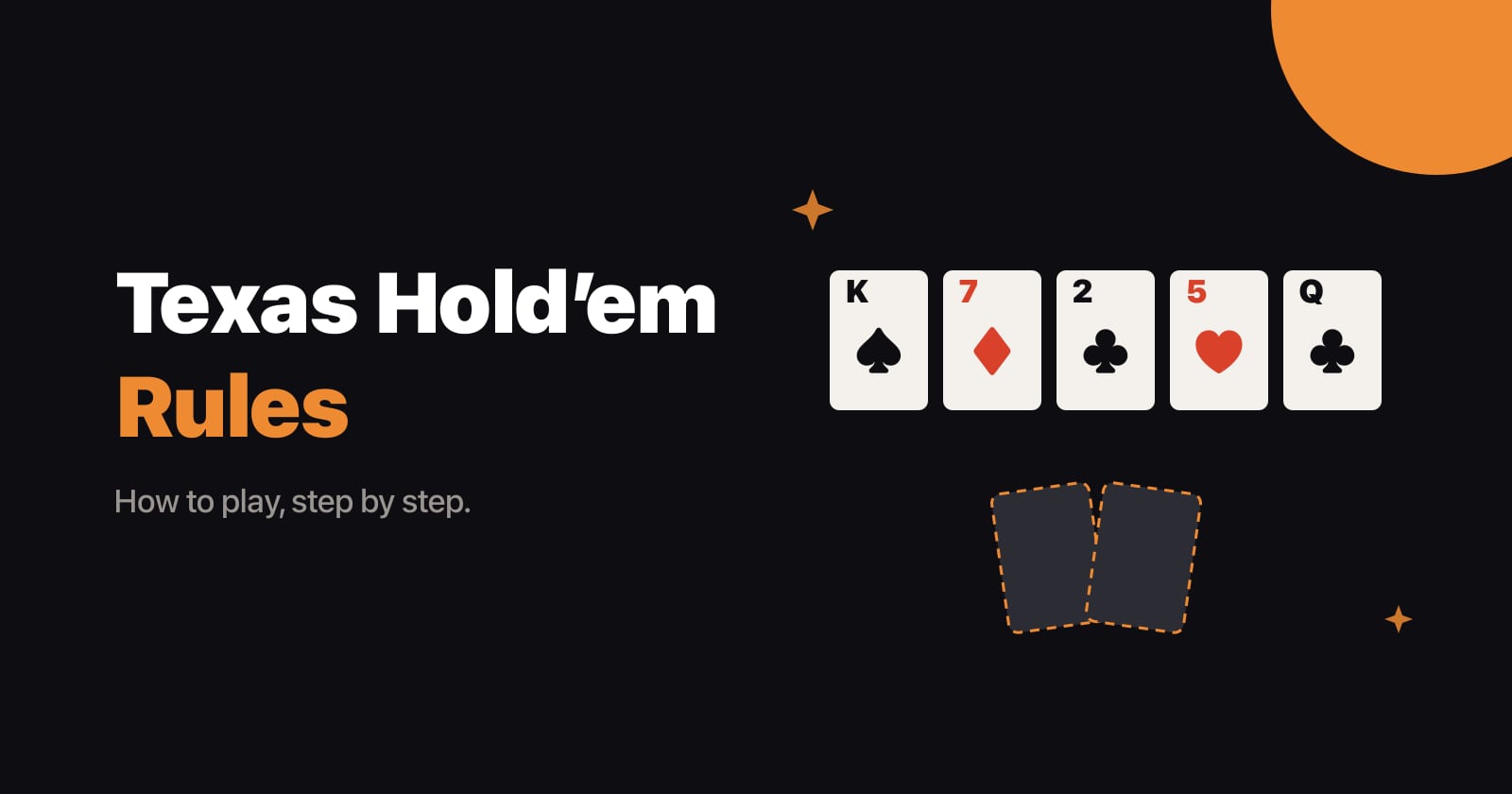
Texas Hold’em is the most played poker game in the world, and its rules start from one deal: each player is dealt two private cards, five shared cards, the community cards, are dealt face up in the middle of the table, and every player makes the best five-card hand they can from the seven. You win the pot in one of two ways: by having the best hand when the cards are shown at the end, or by being the last player left when everyone else has folded. That second way matters more than beginners expect: most pots are won without a showdown, by a bet nobody wanted to call. If you are learning how to play poker, start here: Omaha, Seven Card Stud and most other forms use the same hand rankings and a similar betting structure, so the rules of poker you learn in Hold’em carry over.
How do you play Texas Hold’em, step by step?
One hand of Texas Hold’em poker, from shuffle to pot, in eight steps:
- The button. A disc marks the dealer position. It moves one seat to the left after every hand, and it decides who posts the blinds and who acts first.
- The blinds. The two players to the left of the button post forced bets: the small blind, then the big blind, usually double the small. These give everyone something to play for.
- The deal. Every player gets two cards face down, their hole cards.
- Preflop betting. Starting with the player to the left of the big blind, each player folds, calls the big blind or raises. The blinds act last in this round.
- The flop. The dealer turns three community cards face up, followed by a second round of betting.
- The turn. A fourth shared card, and a third round of betting.
- The river. A fifth and final shared card, and the last round of betting.
- The showdown. If two or more players are still in, they show their cards and the best five-card hand wins the pot.
The dealer also discards, or burns, one card face down before the flop, the turn and the river.
What are the button and the blinds?
The button is the dealer position, and the best seat at the table: from the flop onward, the player on the button acts last on every betting round and sees everyone else’s decision before making theirs. That is why good players raise more hands from the button than from any other seat, and why our poker positions guide starts there.
The blinds are the two forced bets that start every pot. Without them, nobody would have a reason to play anything but premium hands. They rotate with the button, so everyone pays them equally often; small and big blinds explained covers who posts what and how to play from those seats.
The blinds also name the stakes. A $1/$2 Texas Hold’em game has a $1 small blind and a $2 big blind. In a cash game they never change; in a tournament they rise on a fixed schedule, which is what eventually forces players to put their chips at risk. Some live cash games add a third, optional blind called a straddle, which doubles the stakes for one hand.
What can you do when it is your turn?
Five things, depending on whether someone has bet before you in that round:
| Action | What it means | When you can do it |
|---|---|---|
| Fold | Throw your cards away and leave the hand | Any time it is your turn |
| Check | Pass without betting | Only if nobody has bet in this round |
| Call | Match the current bet | When someone has bet |
| Bet | Put chips in first in a round | When nobody has bet yet |
| Raise | Increase the current bet | When someone has bet |
Going all in means putting all of your chips in, as a bet, call or raise. A raise over a raise is called a re-raise, or before the flop a 3-bet.
How do the betting rounds work?
Each round goes around the table clockwise and ends when every player still in the hand has either put in the same amount or folded.
The order changes after the first round. Before the flop, action starts with the player to the left of the big blind and ends with the big blind. From the flop onward, it starts with the first active player to the left of the button, usually the small blind, and ends with the button. Heads up, with only two players, the button posts the small blind and acts first before the flop, then last after it.

-
UTGUnder the gun 1st preflop
-
HJHijack
-
COCutoff
-
BTNButton last after flop
-
SBSmall blind 1st after flop
-
BBBig blind last preflop
If everyone checks, the round ends and the next card comes. If a bet is made, everyone after it must call, raise or fold, and the round continues until the bet is matched or only one player is left.
How much can you bet?
That depends on the betting structure, which the table sets before the game:
- No-limit. You can bet any amount from the size of the big blind up to all your chips. This is the version on television and in almost every online game.
- Pot-limit. The most you can bet is the size of the pot.
- Fixed-limit. Bets and raises come in set amounts, usually with a cap on the number of raises per round.
In no-limit, a raise must be at least as large as the previous bet or raise in that round. If the big blind is $2 and someone raises to $6, a raise of $4, the next raise must make it at least $10.
How does the showdown work?
After the last round of betting, the remaining players show their cards. In most card rooms the last player to bet or raise on the river shows first; if everyone checked, the first player to the left of the button does.
Each player’s hand is the best five cards from their two hole cards and the five on the board. You can use both hole cards, one, or none. If the five board cards beat anything the players can make, everyone still in plays the board and the pot is split. Identical hands split too, and suits never break a tie.
When a player is all in for less than the others have bet, they can only win what they matched from each opponent. The extra chips go into a side pot, which only the players who put them in can win.
What table rules do beginners get wrong?
The poker rules above decide who wins. These decide whether your action counts, and they catch new players in live games all the time. Rooms differ in the details, but most follow the same standard:
- Say it or do it in one motion. Announce “raise” out loud, or put the full raise in with a single forward motion. Putting in a call, then reaching back for more chips, is a string bet, and the dealer will treat it as a call.
- One big chip is a call. Throwing in a single chip larger than the bet, without saying “raise”, counts as a call.
- Verbal is binding. If you say “call” or “raise” in turn, you have to do it.
- Act in turn. Acting before your turn can hold you to that action and gives information away. Wait until the player before you has acted.
- Protect your cards. Keep a hand or a chip on them. If the dealer mixes them into the discards, the hand is usually dead.
- Cards speak. At showdown, the best hand wins even if its owner misreads it. Always turn your cards face up rather than throwing them away with a declaration.
Online, the software enforces all of this for you, which is one reason many players learn the game there first.
What beats what in Texas Hold’em?
From best to worst, the ten hand types are:
- Royal flush: A-K-Q-J-10, all one suit
- Straight flush: five in sequence, one suit
- Four of a kind
- Full house: three of a kind plus a pair
- Flush: any five of one suit
- Straight: five in sequence
- Three of a kind
- Two pair
- One pair
- High card
A flush beats a straight, and a full house beats a flush; those two rules are the ones people forget most. The full chart, with how ties are broken, is in our hand rankings guide, and our poker cheat sheet puts it on one printable page.
An example hand
Here is one hand at a $1/$2 six-handed table, from the blinds to the pot. It uses every rule above: the blinds, a preflop raise, a bet and a call on the flop, a checked-through turn, and a pot won by the last bet rather than at showdown. Step through it with Next:
-
UTGUnder the gun
-
HJHijack
-
COCutoff
-
BTNButton
-
SBSmall blind Posts $1
-
BBBig blind Posts $2
Before any cards are dealt, the small blind posts $1 and the big blind posts $2. The button, marked D, is the dealer position.
- Before any cards are dealt, the small blind posts $1 and the big blind posts $2. The button, marked D, is the dealer position.
- Every player gets two cards face down. We can see two of them: the cutoff has ace-king, the button pocket eights.
- Preflop action starts left of the big blind. Under the gun folds, then the hijack folds.
- The cutoff raises to $6, three times the big blind.
- The button calls $6.
- Both blinds fold. The money they posted stays in the pot, and the preflop round is over.
- The dealer burns one card and turns the flop: K, 7, 2. The pot is $15. After the flop the first player left of the button acts first, which here is the cutoff.
- The cutoff has top pair with the best kicker and bets $8.
- The button calls $8 with a pair of eights, hoping to improve.
- The turn is a 5. The pot is $31. Both players check, so the round ends with no more money in.
- The river is a queen. The cutoff bets $20.
- The button decides a pair of eights is not good enough and folds. The cutoff wins the $31 pot without showing their cards.
How do real hands usually play out?
Mostly before the flop, and mostly heads up after it. We played the whole preflop betting round with a solver’s strategy for all six seats, using the same exported 6-max ranges at 100 big blinds that PlusEV drills, across 300,000 simulated hands. Between 63% and 73% of hands ended before the flop, almost every flop that followed was heads up, and a flop with three or more players came about once in a hundred hands.
Real games are looser, especially live low-stakes ones, where three- and four-way pots are common. But the direction is the lesson: good players fold most hands before the flop, so the first decision, which hands to play from which seat, is where the game is won or lost. Our best starting hands guide and the preflop charts cover exactly that.
What should a beginner learn first?
In this order: the hand rankings, until you never have to think about them; position, because the same hand plays differently from every seat; and a sensible list of starting hands, so you stop paying to see flops with hands that cannot win them. Tracking your own VPIP, the share of hands you play, tells you quickly whether that list is holding.
The game itself fits in one sentence: two private cards, five shared ones, four betting rounds, and the pot goes to the best five-card hand or the last player left. The rules take an evening. Making the right preflop decision every time, quickly, takes practice, and that is what the PlusEV preflop trainer drills, one hand at a time.
Quick answers
How many cards do you get in Texas Hold'em?
Two, dealt face down and seen only by you. Five more are dealt face up in the middle and shared by everyone.
Do you have to use both of your cards?
No. Your hand is the best five cards out of the seven available, so you can use both hole cards, one, or none. Using none is called playing the board.
Who acts first in Texas Hold'em?
Before the flop, the player to the left of the big blind. After the flop, the first player still in the hand to the left of the dealer button. The button acts last on every street after the flop.
Can you check before the flop?
Only the big blind, and only when nobody has raised. Everyone else must fold, call the big blind or raise, because the big blind is already a bet.
What happens if two players have the same hand?
They split the pot. Suits never break a tie in Texas Hold'em.
Which comes first, the flop or the river?
The flop. Three community cards come on the flop, then one on the turn, then one on the river, with a betting round after each.
What are the most common beginner mistakes in Texas Hold'em?
Playing too many hands, ignoring position, and calling too often instead of raising or folding. Most of the money in beginner games is lost before the flop, by entering pots with hands that should have been folded.
How many players can play Texas Hold'em?
Two to ten. Online games are usually six-handed or nine-handed, and live casino tables usually seat nine or ten.