

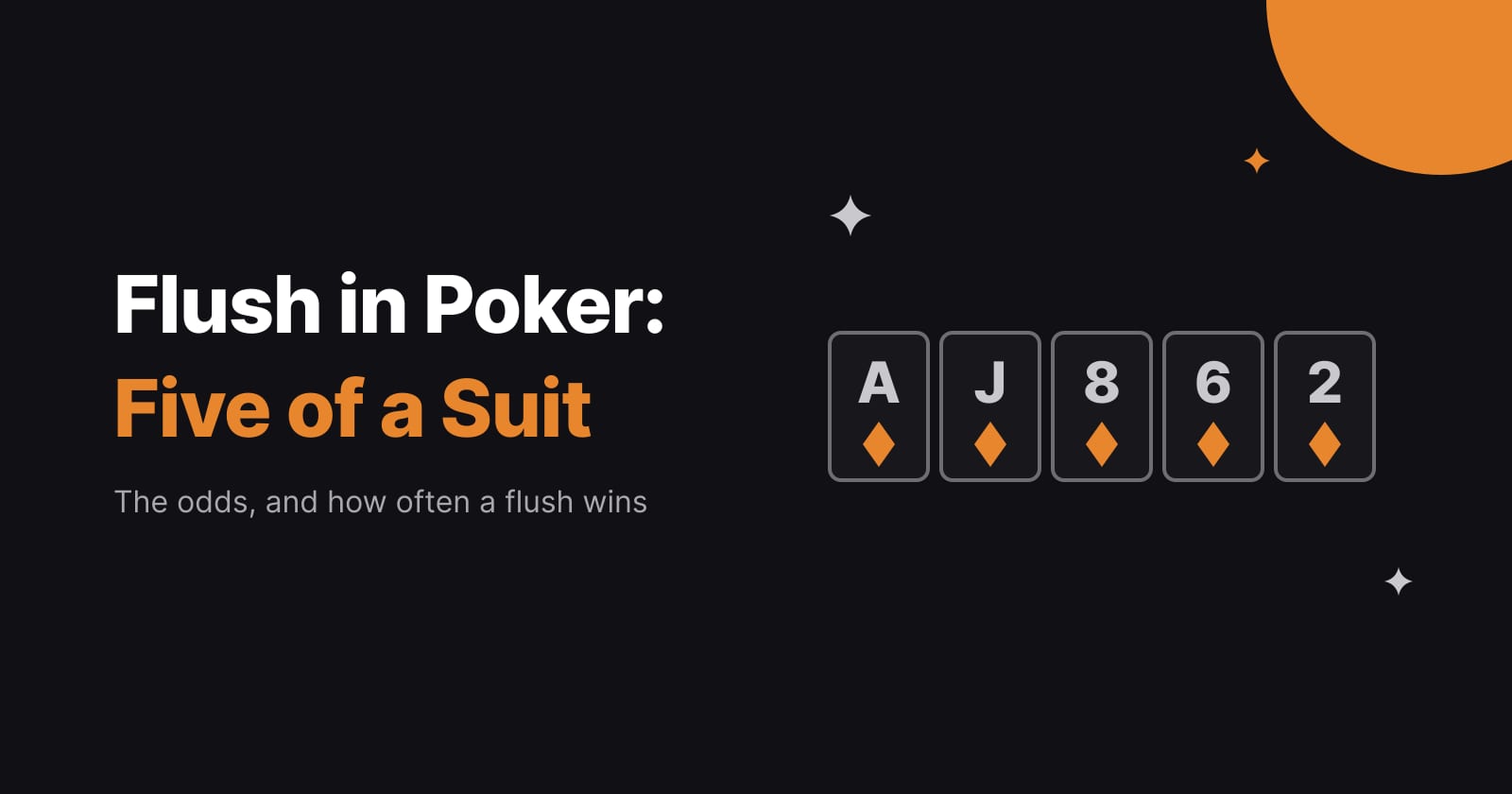
What is a flush in poker?
A flush in poker is any five cards of the same suit. The ranks do not have to connect: the ace, jack, eight, six and two of diamonds is a flush. It ranks fifth of the ten hands, so it beats a straight, three of a kind and everything below, and it loses to a full house, four of a kind and a straight flush. Our hand rankings chart shows the full order.
Which flush wins when two players have one?
The one with the highest card. This part is standard rules, not our data. An ace-high flush beats a king-high flush, and if the top cards match, the next cards are compared down all five. Suits have no rank, so a flush in spades is worth the same as one in hearts.
In Texas Hold’em two flushes are always in the same suit, because five board cards cannot hold three of two suits. The only tie is a flush that sits entirely on the board and that no player can improve.
What are the odds of making a flush?
Low for any one hand, and much better with two suited cards. This part is exact arithmetic, not our data:
| Situation | Chance of a flush |
|---|---|
| Five cards dealt at once | 0.197%, 1 in 509 |
| Any Hold’em hand by the river | 3.0% |
| Two suited cards, by the river | 6.4% |
| Two offsuit cards, by the river | 1.85% |
| Two suited cards, on the flop | 0.84% |
| Two suited cards flop a flush draw | 10.9% |
| A flush draw on the flop, by the river | 35.0% |
A flush draw has nine outs, which hit 19.1% of the time on the turn and 19.6% on the river. The poker odds guide has the same figures for every other draw. A flush is rarer than a straight in five cards, 5,108 ways against 10,200, which is why it ranks higher.
How often does a flush win?
About 85% of the time against one random hand. We dealt 4,000,000 random two-player hands to the river with the same evaluator as our equity calculator and looked at every flush:
| Cards of the suit on the board | Share of flushes | Wins | Ties | Loses |
|---|---|---|---|---|
| Three, so you use both hole cards | 44.4% | 96.4% | 0% | 3.6% |
| Four, so you use one hole card | 49.1% | 82.8% | 0% | 17.2% |
| Five, a flush on the board | 6.5% | 22.9% | 53.0% | 24.1% |
| Every flush | 100% | 84.9% | 3.4% | 11.6% |
In PlusEV’s simulation of 4,000,000 two-player deals, a flush won the showdown 84.9% of the time, and 85.9% of the flushes that lost were beaten by a bigger flush. A full house took 11.5% of the losses, and a straight flush or four of a kind the rest.
The board decides how safe a flush is. With three of the suit out, an opponent needs two of that suit to have a flush at all. With four out, any single higher card of the suit beats you.
What is the nut flush?
The best flush the board allows, which no other flush can beat. It is usually the one with the ace of the suit, or the king when the ace is on the board. We took two suited hole cards on a board with exactly three of the suit and counted how often a random opponent holds a bigger flush:
| Your highest card of the suit | One opponent has a bigger flush | At least one of five does |
|---|---|---|
| Ace | never | never |
| King | 0.52% | 2.6% |
| Queen | 1.00% | 4.9% |
| Jack | 1.37% | 6.9% |
| Ten | 1.73% | 8.6% |
| Eight | 2.29% | 11.3% |
| Six | 2.71% | 12.9% |
In PlusEV’s count, a king-high flush made with both hole cards runs into a bigger flush 0.52% of the time against one random hand and 2.6% of the time against five. These opponents hold random cards. Real opponents fold most offsuit hands and keep suited aces, so at a real table the risk to a small flush is higher than this. Losing a flush to a bigger one is a classic cooler.
Why do solver ranges prefer suited hands?
Because a suited hand makes a flush more than three times as often as an offsuit one, 6.4% against 1.85%, and flops a draw it can keep betting with. In PlusEV’s 6-max solver ranges the cutoff opens 49.7% of suited combos and 15.7% of offsuit combos, as our offsuit guide breaks down seat by seat.
| AA | AKs | AQs | AJs | ATs | A9s | A8s | A7s | A6s | A5s | A4s | A3s | A2s |
| AKo | KK | KQs | KJs | KTs | K9s | K8s | K7s | K6s | K5s | K4s | K3s | K2s |
| AQo | KQo | QJs | QTs | Q9s | Q8s | Q7s | Q6s | Q5s | Q4s | Q3s | Q2s | |
| AJo | KJo | QJo | JJ | JTs | J9s | J8s | J7s | J6s | J5s | J4s | J3s | J2s |
| ATo | KTo | QTo | JTo | TT | T9s | T8s | T7s | T6s | T5s | T4s | T3s | T2s |
| A9o | K9o | Q9o | J9o | T9o | 99 | 98s | 97s | 96s | 95s | 94s | 93s | 92s |
| A8o | K8o | Q8o | J8o | T8o | 98o | 88 | 87s | 86s | 85s | 84s | 83s | 82s |
| A7o | K7o | Q7o | J7o | T7o | 97o | 87o | 77 | 76s | 75s | 74s | 73s | 72s |
| A6o | K6o | Q6o | J6o | T6o | 96o | 86o | 76o | 66 | 65s | 64s | 63s | 62s |
| A5o | K5o | Q5o | J5o | T5o | 95o | 85o | 75o | 65o | 55 | 54s | 53s | 52s |
| A4o | K4o | Q4o | J4o | T4o | 94o | 84o | 74o | 64o | 54o | 44 | 43s | 42s |
| A3o | K3o | Q3o | J3o | T3o | 93o | 83o | 73o | 63o | 53o | 43o | 33 | 32s |
| A2o | K2o | Q2o | J2o | T2o | 92o | 82o | 72o | 62o | 52o | 42o | 32o | 22 |
How should you play a flush?
This part is standard theory:
- Bet it. A flush is the best hand most of the time, and worse hands pay to see it.
- Be careful with a small flush on a four-flush board. One higher card of the suit beats you, and a big bet from an opponent often means they hold it.
- Watch a paired board. A full house is possible only when the board pairs.
- Draw to the big flush. A draw to the ace-high flush cannot run into a bigger one. A draw to a small flush, the kind suited connectors make, can.
A flush in poker is five cards of one suit: a 6.4% shot with suited cards, and a winner about 85% of the time when it comes. The PlusEV preflop trainer drills which suited hands to play from each seat, so the flushes you make are the big ones.
Quick answers
What is a flush in poker?
Five cards of the same suit, in any order, such as the ace, jack, eight, six and two of diamonds. If the five are also in sequence it is a straight flush, a much stronger hand.
Does a flush beat a straight?
Yes. A flush beats a straight and everything below it, and loses to a full house, four of a kind and a straight flush.
Who wins if two players both have a flush?
The flush with the highest card. If those match, the second-highest cards are compared, and so on down all five. Suits have no rank, so spades are no better than hearts.
How likely is a flush in poker?
In five cards, 1 in 509. In Texas Hold'em, two suited cards make a flush 6.4% of the time by the river, and an offsuit hand 1.85% of the time.
What is a nut flush?
The best flush that the board allows, usually the one holding the ace of the suit. No other flush can beat it.
What are the odds of hitting a flush draw?
With four of a suit after the flop you have nine outs: 19.1% on the turn, 19.6% on the river, and 35.0% by the river if you see both cards.