

What is a full house in poker?
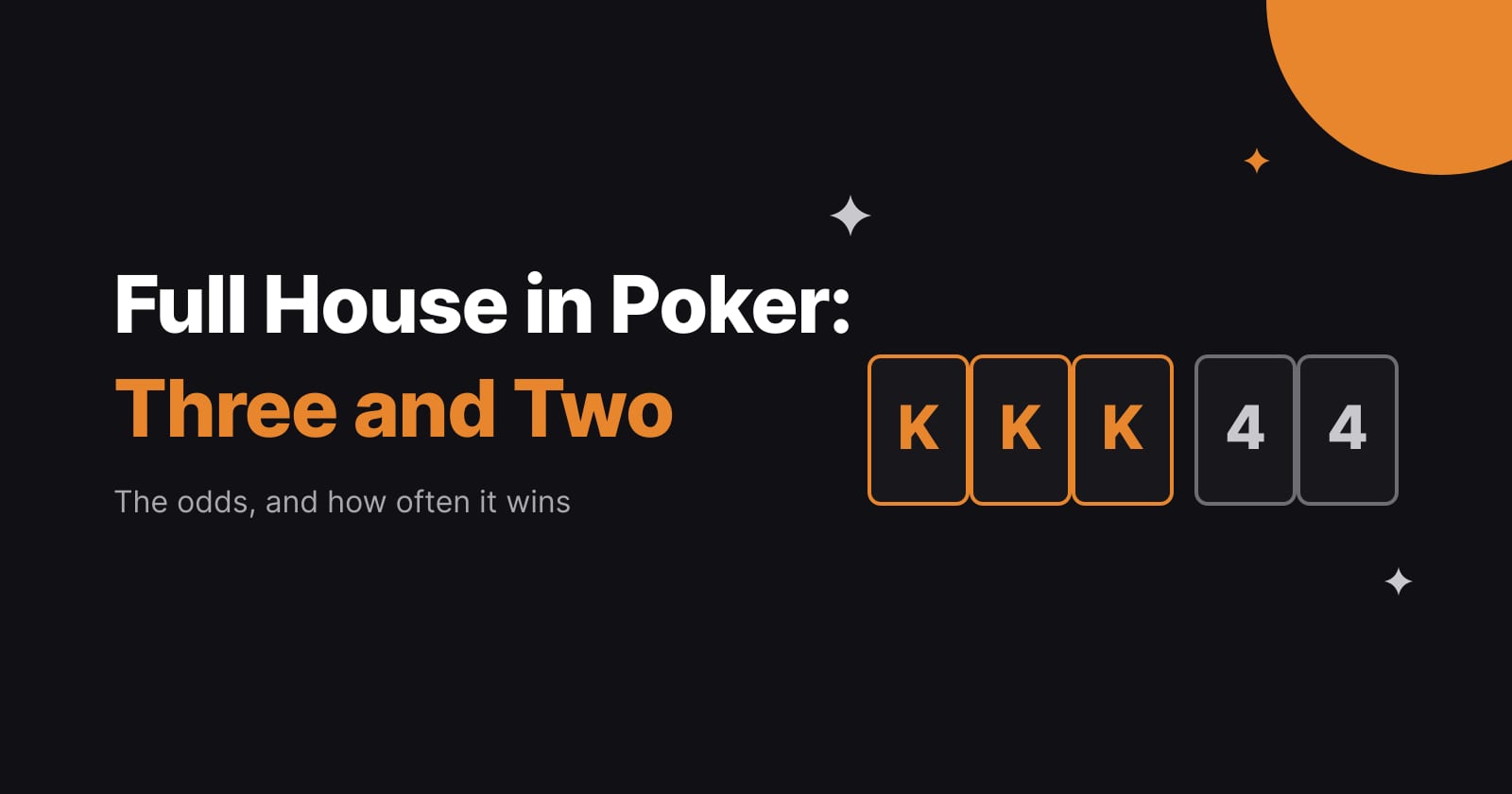
A full house in poker is three cards of one rank and two of another: three kings and two fours, for example. Players call that kings full of fours, naming the three of a kind first, and the hand is also known as a boat or full boat. It ranks fourth of the ten hands, as our hand rankings chart shows.
What beats a full house?
Four of a kind, a straight flush and a royal flush. This part is standard rules, not our data. A full house beats a flush, a straight and everything below them.
Between two full houses the three of a kind decides first, so queens full of twos beats jacks full of aces. The pair matters only when both players hold the same three of a kind, which takes shared board cards: kings full of fours beats kings full of threes.
What are the odds of making a full house?
Long in five cards, and much shorter once you hold a set. This part is exact arithmetic, not our data:
| Situation | Chance of a full house |
|---|---|
| Five cards dealt at once | 0.144%, 1 in 694 |
| Any Hold’em hand by the river | 2.6% |
| A pocket pair, on the flop | 0.98% |
| A set on the flop, full house or better by the river | 33.4% |
| Two pair on the flop, by the river | 16.5% |
A set improves so often because it has seven outs on the turn and ten on the river: the last card of your rank, plus every card that pairs the board. The poker odds guide has the same table for every other draw.
Which starting hands make the most full houses?
Pocket pairs, by a wide margin. We counted every one of the 2,118,760 possible boards for each starting hand:
| Starting hand | Full house by the river | Four of a kind by the river |
|---|---|---|
| Any pocket pair | 8.55% | 0.84% |
| Any two unpaired cards | 2.22% | 0.13% |
| Every hand, averaged | 2.60% | 0.17% |
By PlusEV’s exact count over all 2,118,760 boards, a pocket pair ends with a full house 8.55% of the time by the river, almost four times as often as two unpaired cards at 2.22%. The rank does not matter: aces and deuces fill up equally often, and so do ace-king and seven-two.
That is a large part of why small pairs are worth playing. In the 6-max solver ranges PlusEV drills, every pair from sixes up is a raise from under the gun, as our pocket pairs guide covers seat by seat.
| AA | AKs | AQs | AJs | ATs | A9s | A8s | A7s | A6s | A5s | A4s | A3s | A2s |
| AKo | KK | KQs | KJs | KTs | K9s | K8s | K7s | K6s | K5s | K4s | K3s | K2s |
| AQo | KQo | QJs | QTs | Q9s | Q8s | Q7s | Q6s | Q5s | Q4s | Q3s | Q2s | |
| AJo | KJo | QJo | JJ | JTs | J9s | J8s | J7s | J6s | J5s | J4s | J3s | J2s |
| ATo | KTo | QTo | JTo | TT | T9s | T8s | T7s | T6s | T5s | T4s | T3s | T2s |
| A9o | K9o | Q9o | J9o | T9o | 99 | 98s | 97s | 96s | 95s | 94s | 93s | 92s |
| A8o | K8o | Q8o | J8o | T8o | 98o | 88 | 87s | 86s | 85s | 84s | 83s | 82s |
| A7o | K7o | Q7o | J7o | T7o | 97o | 87o | 77 | 76s | 75s | 74s | 73s | 72s |
| A6o | K6o | Q6o | J6o | T6o | 96o | 86o | 76o | 66 | 65s | 64s | 63s | 62s |
| A5o | K5o | Q5o | J5o | T5o | 95o | 85o | 75o | 65o | 55 | 54s | 53s | 52s |
| A4o | K4o | Q4o | J4o | T4o | 94o | 84o | 74o | 64o | 54o | 44 | 43s | 42s |
| A3o | K3o | Q3o | J3o | T3o | 93o | 83o | 73o | 63o | 53o | 43o | 33 | 32s |
| A2o | K2o | Q2o | J2o | T2o | 92o | 82o | 72o | 62o | 52o | 42o | 32o | 22 |
How often does a full house win?
About 87% of the time against one random hand, and how often depends on the board. We dealt 4,000,000 random two-player hands to the river and looked at every full house:
| The board shows | Share of full houses | Wins | Ties | Loses |
|---|---|---|---|---|
| One pair | 40.5% | 99.1% | 0.1% | 0.8% |
| Two pair | 30.4% | 91.3% | 4.0% | 4.7% |
| Three of a kind | 23.8% | 78.9% | 6.6% | 14.5% |
| A full house | 5.3% | 6.6% | 82.2% | 11.2% |
| Every full house | 100% | 87.0% | 7.2% | 5.8% |
In PlusEV’s simulation of 4,000,000 two-player deals, a full house won the showdown 87.0% of the time: 99.1% with one pair on the board, and 78.9% with three of a kind on the board. Of the full houses that lost, 76.6% were beaten by a bigger full house and 23.3% by four of a kind.
With one pair on the board you need both hole cards, or a pocket pair that made a set, and an opponent almost never has better. With three of a kind on the board, any pocket pair makes a full house, and the bigger pair wins.
How should you play a full house?
This part is standard theory:
- Bet it for value. A full house beats every flush and straight, and those hands pay.
- Know which full house you have. With a set on a paired board you usually hold the best one. With one card matching the smaller pair on a two-pair board, a player holding the bigger pair’s card beats you.
- Slow down on three-of-a-kind boards. Your small pocket pair makes a full house, and so does every bigger pair.
- Do not wait too long. Checking to trap gives a flush draw or straight draw a free card and wins nothing when the opponent has no hand.
A full house in poker is three of one rank and two of another: a 2.6% hand on average, 8.55% with a pocket pair, and a winner 87% of the time. The PlusEV preflop trainer drills which pairs to open from each seat, so you are in the pot when the board pairs.
Quick answers
What is a full house in poker?
Three cards of one rank and two of another, such as king-king-king-four-four. Players name it by the three first: kings full of fours.
What beats a full house in poker?
Four of a kind, a straight flush and a royal flush. A bigger full house also beats a smaller one.
Does a full house beat a flush?
Yes. A full house beats a flush and a straight. In five cards there are 3,744 full houses against 5,108 flushes, so the full house is rarer and ranks higher.
Which full house wins?
The one with the higher three of a kind. Queens full of twos beats jacks full of aces. If the three match, the higher pair wins.
What is a boat in poker?
Another name for a full house, short for full boat. Kings full of fours is a boat.
What are the odds of getting a full house?
In five cards, 1 in 694. In Texas Hold'em a hand ends with a full house 2.6% of the time by the river, and a pocket pair 8.55% of the time.