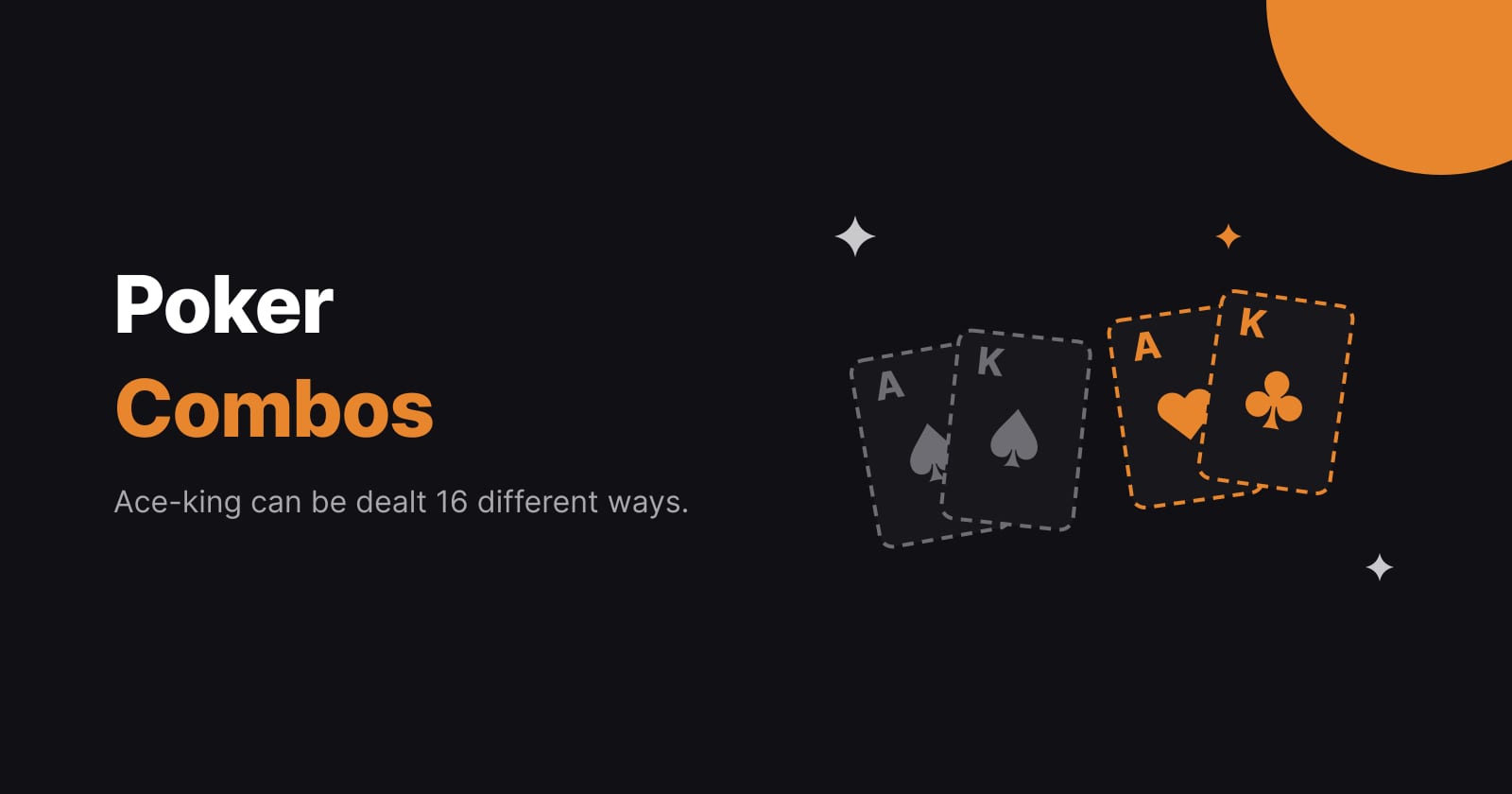
Poker combos are the exact two-card ways a hand can be dealt. A chart shows ace-king as
one cell, but at the table it is sixteen different pairs of cards: four aces times four
kings. Counting in combos instead of hands is what keeps range maths honest, because some
hands are far more likely to be dealt than others.
Hand type
Hands
Combos each
Combos total
Share of all hands
Pocket pairs
13
6
78
5.9%
Suited
78
4
312
23.5%
Offsuit
78
12
936
70.6%
All starting hands
169
1,326
100%
The 1,326 is every way to pick two cards from 52. The 169 is how many different hands a
chart needs, once suits that play the same are grouped together.
Combos are not the same thing as “poker combinations” in the sense of a flush or a full
house. Those are the five-card hands, and their order is on our
poker hand rankings chart.
Why does ace-king have 16 combos and aces only 6?
Because an unpaired hand can use any ace with any king, and a pair has to pick two cards
of one rank. Ace-king is 4 × 4 = 16: four of those share a suit (the suited combos) and
the other 12 do not. Pocket aces need two of the four aces, and there are only six ways
to choose two from four.
So ace-king is dealt 2.7 times as often as aces, and any one offsuit hand three times as
often as its suited version. A range that looks mostly suited on a chart can still be
mostly offsuit in what actually gets played.
How many combos are in a preflop range?
Count the combos of every hand in it, and count a hand played part of the time in
proportion: a hand raised half the time adds half its combos. Here are the opening ranges
PlusEV drills, 6-max cash at 100 big blinds, counted that way:
Seat
Opening range
Share of all hands
Pairs
Suited
Offsuit
Under the gun
232.1 combos
17.5%
27%
43%
30%
Hijack
286.4 combos
21.6%
24%
42%
35%
Cutoff
377.9 combos
28.5%
20%
41%
39%
Button
537.5 combos
40.5%
14%
38%
49%
Small blind (raises)
345.7 combos
26.1%
13%
42%
46%
Every percentage on our preflop charts comes from this
count. When PlusEV’s solver ranges say under the gun opens 17.5% of hands, that is 232 of
the 1,326 combos.
The mix shifts as the range widens. Under the gun opens mostly pairs and suited hands, and
offsuit hands are under a third of the range. On the button, offsuit hands are the largest
group at 49%, because each one that gets added brings 12 combos with it. The small blind
also limps another 394 combos on top of the raises above.
The combo counter at the top of this page has each of these ranges as a preset. Load one,
tap the cards you hold and watch the count move.
How do the cards you can see change the count?
Every card you can see is a card your opponent cannot hold. Your own two cards and the
board remove combos from their range, and the effect follows fixed rules:
Their hand
Normally
You hold one of its cards
You hold two of its cards
A pocket pair, like AA
6
3
1
Ace-king, any suits
16
12
9 (one ace, one king)
Ace-king suited
4
3
2
Ace-king offsuit
12
9
7
This is card removal, and using it on purpose is what blockers in
poker are about. In a real range the effect is real but
modest. Facing a button open, the big blind’s 3-bet range in PlusEV’s charts is 191
combos, and 34 of them (17.8%) are aces, kings, queens or ace-king. If the button holds
the ace of spades, those drop to 27 of 172 combos (15.7%). Holding the ace of spades and
the king of diamonds, 21 of 157 (13.4%).
How many combos of sets, two pair and flush draws are there?
The same counting works on the flop, with the board cards treated as dead, and it shows
how few combos a strong hand really is. On K♥ 9♠ 4♦:
Sets: 3 combos each of kings, nines and fours, so 9 in all.
Pairs not on the board: 6 combos each, like aces or queens.
Two pair: 9 combos of king-nine (3 kings left times 3 nines).
Top pair with a big kicker: 12 combos of ace-king (4 aces times 3 kings).
Flush draws: with two hearts on the board instead, 55 combos hold two more hearts
(11 hearts left, any two of them), six times as many as the sets.
How do combos decide a river call?
By comparing how many combos beat you with how many you beat, then checking the price.
This is a worked illustration of standard theory, not solver output.
The board runs out K♥ 9♥ 4♦ 2♣ 7♠ and your opponent bets the size of the pot. Calling a
pot-sized bet needs you to be right at least a third of the time. Say their betting range
is sets of kings, nines and fours, king-nine for two pair, and eight missed heart draws
such as A♥Q♥, J♥10♥ and 6♥5♥, one combo each.
You hold Q♦Q♣. Their value is 3 + 3 + 3 combos of sets plus 9 of king-nine: 18. Against
8 bluffs, they are bluffing 8 of 26 times, 30.8%. That is short of the third you need, so
it is a fold.
You hold K♦Q♣. Same strength in practice, since you beat only the bluffs. But your king
leaves just 1 combo of kings and 6 of king-nine, so their value drops to 13. Now the
bluffs are 8 of 21, 38.1%, and the call is profitable.
You hold A♥K♦. Your king removes the same value, but your ace of hearts also removes
four of their eight bluffs. They are bluffing 4 of 17 times, 23.5%: a fold. Nothing about
the board changed between these three hands. Only the cards you hold, and therefore the
combos left in their range. The pot odds guide
covers the price side of the same decision.
Which hands cost players the most once combos are counted?
Offsuit broadway and ace-x hands, by a distance. Across PlusEV’s 1M+ graded training
decisions, ace-five suited is the single most misplayed hand: players pick the right
action 72.0% of the time. But it is dealt only 4 ways. Ace-jack offsuit is nearly as hard
(72.1%) and is dealt 12 ways, so at a real table it produces almost three times as many
mistakes.
Weight each hand’s error rate by how often it is dealt and the list turns over:
Hand
Right answer chosen
Combos
Share of all mistakes
Rank by accuracy alone
AJo
72.1%
12
2.1%
2nd
QJo
72.4%
12
2.1%
3rd
KJo
75.0%
12
1.9%
10th
ATo
75.3%
12
1.9%
12th
A2o
75.6%
12
1.9%
13th
KTo
76.3%
12
1.8%
14th
A9o
76.8%
12
1.8%
16th
AQo
77.3%
12
1.7%
20th
A5s
72.0%
4
0.7%
1st
All 15 of the costliest hands are offsuit, and offsuit hands make up 59.7% of all
mistakes when hands are weighted by how often they are dealt. Players actually get offsuit
hands right more often than suited ones (90.1% against 83.8% on average), but there are
three times as many of them.
The method, so the figures can be checked: standardised accuracy for all 169 hands,
counting only spots with one clear solver answer and weighting every difficulty level
equally, with at least 770 answers from 357 players behind each hand.
The full list of hard hands is in the worst hands in poker.
How do you count combos quickly at the table?
Memorise four numbers and two removal rules, then practise until you stop doing
arithmetic:
6 for a pair, 4 for a suited hand, 12 for offsuit, 16 for any unpaired
hand.
A pair with one card seen: 3 combos. With two seen: 1.
An unpaired hand with one card seen: 12. With one of each rank seen: 9.
Sets on an unpaired board: 3 per board card.
Nobody adds up 537 combos mid-hand. What players actually do is compare blocks: “they have 9
combos of sets and maybe 12 of ace-king, but 30-odd combos of draws”. Knowing the counts
and using them in a ten-second decision are different skills, and only repetition closes
that gap. For the preflop half of it, the PlusEV trainer deals you real spots until
the ranges behind these counts stop needing a chart.
Poker combos come down to one fact: ace-king is 16 hands and aces are 6, and every card
you can see changes those numbers. Count your opponent’s range that way and the close
calls stop being guesses.
Quick answers
How many combos are there in poker?
1,326 two-card starting hands, grouped into 169 hand types: 78 combos of pocket pairs, 312 suited and 936 offsuit. Each pocket pair can be dealt 6 ways, each suited hand 4 ways and each offsuit hand 12 ways.
How many combos of pocket aces are there?
Six. If you hold one ace there are 3 left, and if you hold two aces there is only 1.
How many combos of ace-king are there?
Sixteen: 4 suited and 12 offsuit. Holding one ace or one king leaves 12, and holding an ace and a king leaves 9.
What percentage of starting hands are pocket pairs?
5.9%. There are 78 pocket pair combos among the 1,326 starting hands, so you are dealt a pair about once every 17 hands.
How many combos make a set on the flop?
Three for each rank on an unpaired flop. On K-9-4 your opponent can hold kings, nines or fours 3 ways each, 9 set combos in all, against 6 for any pocket pair not on the board.
Are poker combos the same as poker hand rankings?
No. Combos count the ways two specific cards can be dealt. Hand rankings order the five-card hands, from high card up to a royal flush.