

What is limping in poker?
Calling the big blind before the flop instead of raising. The player limps in: they put in the minimum it costs to see a flop and nothing more, and a player who does it is called a limper.
Checking in the big blind is not a limp. When nobody raises, the big blind’s forced bet already matches the price, so checking costs nothing extra and is the big blind’s option, not a decision to limp in.
It has a bad reputation, and mostly it has earned it. Most of this page is about the one place it has not.
What kinds of limp are there?
Five, and they get lumped together far more than they should.
- Open limp. You are first into the pot and you call the big blind. This is the one people mean when they say never limp.
- Overlimp. Somebody has already limped and you limp behind them.
- Limp-call. You limp, somebody raises, and you call the raise.
- Limp-reraise, also called a limp-raise. You limp, somebody raises, and you re-raise. It is a trap, usually with a strong hand.
- Completing the small blind. You are in the small blind and you top up to a full big blind. Folded to you, this is an open limp from the one seat where the solver actually does it.
The charts below cover the first and the last: the pot folded to you, nobody in yet.
Is limping ever correct?
In a 6-max cash game at 100 big blinds, played against opponents who are also playing well, from four of the five opening seats the answer is no. The frequency is zero.
Under the gun, the hijack, the cutoff and the button each have two actions in their opening chart and limping is not one of them. They raise or they fold:
| Seat | Raise | Limp | Fold |
|---|---|---|---|
| UTG | 17.5% | 0% | 82.5% |
| Hijack | 21.6% | 0% | 78.4% |
| Cutoff | 28.5% | 0% | 71.5% |
| Button | 40.5% | 0% | 59.5% |
| Small blind | 26.1% | 29.7% | 44.2% |
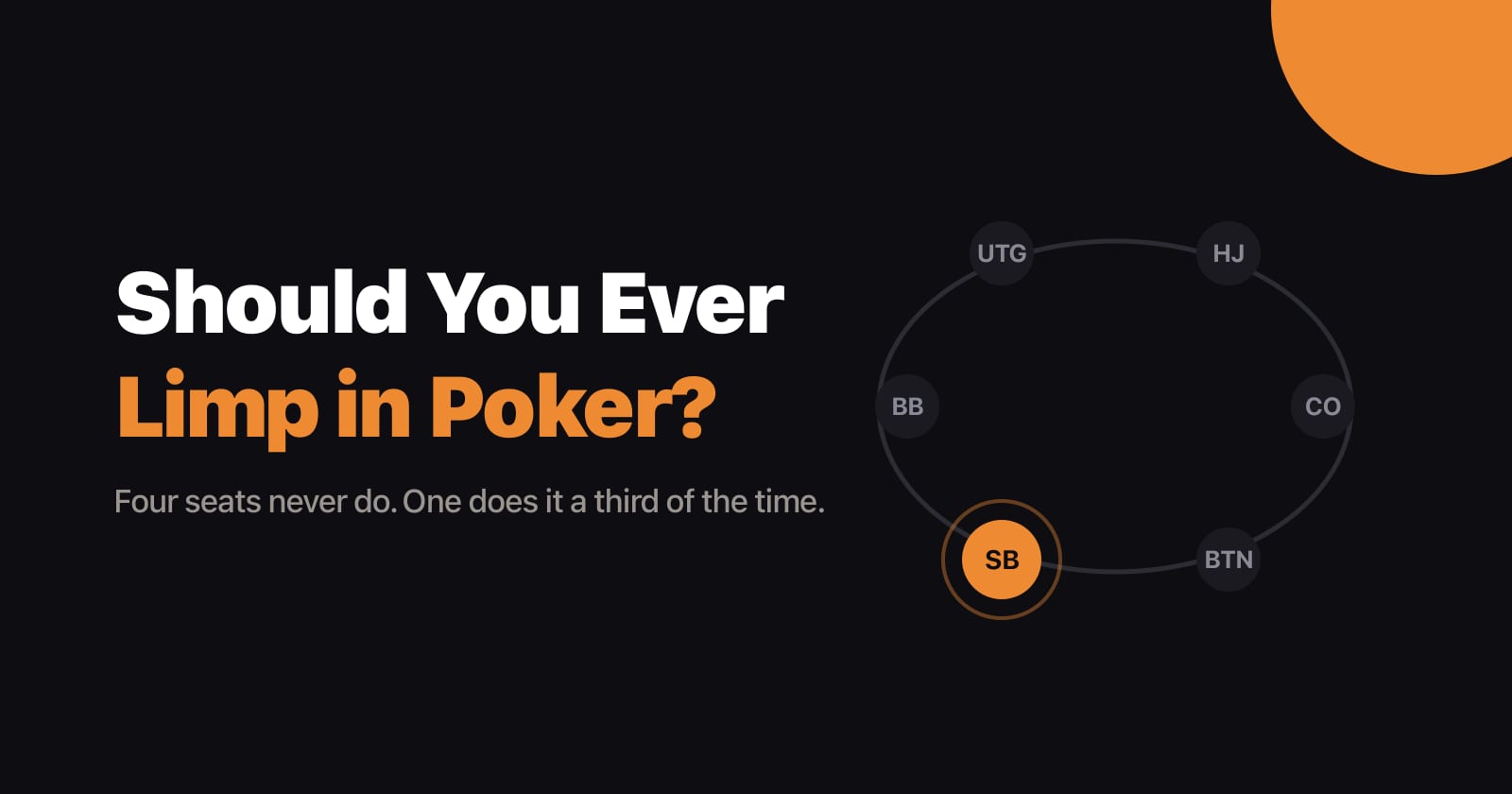
In the 6-max cash solutions PlusEV drills, the small blind limps 29.7% of hands and raises 26.1%, while every other opening seat limps none. Limping is its most common action after folding.
What these numbers are, and are not. Every figure on this page comes from 6-max cash game solutions at 100 big blinds with the opening sizes those charts use. Change the format and the answer can change with it: full ring, short stacks, tournaments with antes, and pots where several players have already limped are all different problems with different solutions, and none of them is solved here.
They are also equilibrium numbers, which means they assume the player behind you is capable of punishing a bad limp. Against a table that folds too much, or one that never raises a limper, deliberately limping a strong hand to trap can make money that the solver leaves behind. That is a real and legitimate way to play, it is simply not what a GTO chart is for, and it is a story for another time. Read the zeroes as the baseline you deviate from on purpose, never by drift.
One tournament spot comes up often enough to name. With a short stack, around 10 to 20 big blinds, limping a strong hand from the small blind is a common play, because a big blind who shoves over the limp is shoving into it. That is standard tournament practice rather than anything these cash-game charts measure.
Why is open limping bad from most seats?
Because it gives away the three things a raise buys.
You cannot win the pot before the flop. A raise folds out the blinds and everyone behind a good share of the time; a limp never does, so every limp commits you to seeing a flop.
You invite a crowd. Anyone behind can call the same cheap price, and limped pots go multiway, where marginal hands lose value fastest.
And you tell the table what you have. A player who raises good hands and limps the rest has split their range in public, and the players behind can raise the limp every time knowing the hand behind it is capped.
Why does only the small blind limp?
Because it is the only seat where all three of those costs disappear at once.
From the small blind there is exactly one player left, the big blind, and the price is already half paid. You are not inviting a field. You are offering one opponent a flop in a pot you are partly invested in already, and there is nobody behind them to squeeze you.
Is the button really not a limping seat?
No, and this surprises people more than the small blind does. Position is exactly why raising is better, not a reason to see a cheap flop: the two blinds act first on every street, and a raise wins the pot outright a large share of the time. Limping gives up that fold equity to save one big blind. The button chart opens 40.5% of hands and limps none of them.
What does the small blind’s limping range look like?
Wider than its raising range and shaped completely differently. Split by hand type, out of the combinations available:
| Shape | Limp | Raise | Fold | Limp share of played hands |
|---|---|---|---|---|
| Pairs | 35 | 43 | 0 | 44.4% |
| Suited | 114 | 144 | 54 | 36.5% |
| Offsuit | 246 | 158 | 532 | 26.3% |
Pairs limp most readily, offsuit hands least, and no pair is ever folded. The limping range runs to 107 distinct hands, which is more than most players open with from any seat.
Here is the chart itself. It is a raise-first-in chart, meaning the pot has been folded all the way to the small blind and nobody has put in a raise. The green band marked “Call” is the limp: with no raise to call, calling the big blind is what limping is.
| AA | AKs | AQs | AJs | ATs | A9s | A8s | A7s | A6s | A5s | A4s | A3s | A2s |
| AKo | KK | KQs | KJs | KTs | K9s | K8s | K7s | K6s | K5s | K4s | K3s | K2s |
| AQo | KQo | QJs | QTs | Q9s | Q8s | Q7s | Q6s | Q5s | Q4s | Q3s | Q2s | |
| AJo | KJo | QJo | JJ | JTs | J9s | J8s | J7s | J6s | J5s | J4s | J3s | J2s |
| ATo | KTo | QTo | JTo | TT | T9s | T8s | T7s | T6s | T5s | T4s | T3s | T2s |
| A9o | K9o | Q9o | J9o | T9o | 99 | 98s | 97s | 96s | 95s | 94s | 93s | 92s |
| A8o | K8o | Q8o | J8o | T8o | 98o | 88 | 87s | 86s | 85s | 84s | 83s | 82s |
| A7o | K7o | Q7o | J7o | T7o | 97o | 87o | 77 | 76s | 75s | 74s | 73s | 72s |
| A6o | K6o | Q6o | J6o | T6o | 96o | 86o | 76o | 66 | 65s | 64s | 63s | 62s |
| A5o | K5o | Q5o | J5o | T5o | 95o | 85o | 75o | 65o | 55 | 54s | 53s | 52s |
| A4o | K4o | Q4o | J4o | T4o | 94o | 84o | 74o | 64o | 54o | 44 | 43s | 42s |
| A3o | K3o | Q3o | J3o | T3o | 93o | 83o | 73o | 63o | 53o | 43o | 33 | 32s |
| A2o | K2o | Q2o | J2o | T2o | 92o | 82o | 72o | 62o | 52o | 42o | 32o | 22 |
Read it as three groups rather than two. The hands shaded entirely orange always raise, the hands shaded entirely green always limp, and the split cells are played both ways at the proportion the colours show. A cell that is 40% green is a hand you limp four times in ten and raise the other six.
Why do aces and kings limp?
To protect the rest of the limping range, and because the small blind is the one seat where a big pot is not obviously good news.
| Hand | Limp | Raise |
|---|---|---|
| AA | 24.6% | 75.4% |
| KK | 41.6% | 58.4% |
| 31.4% | 68.6% | |
| JJ | 39.4% | 60.6% |
| AKo | 36.8% | 63.2% |
| AQo | 43.2% | 56.8% |
Kings limp more often than aces. Ace-queen offsuit limps more often than either. If the limping range held only weak hands, the big blind could raise it every time and print money. Putting kings in there makes that attack expensive, which is what lets the weak part of the range exist at all.
Why does ace-king suited never limp?
Because it is the hand that least wants a small pot.
Ace-king suited raises 100% of the time from the small blind. Ace-king offsuit limps 36.8%. The two hands differ by one property, and that property is how much equity they realise when the money goes in: the suited version makes nut flushes, so it gains more from building a pot than it loses from folding out weaker hands.
The same logic puts ATs, A9s, A8s, QJs, QTs and JTs in the never-limp group. Every one is a suited hand that flops well enough to want the pot larger.
How do you play against a limper?
Mostly by raising. The figures in this section are standard practice rather than solver output: the charts above cover a pot folded to you, and a pot with a limper already in it is a different spot we have not published solutions for.
Raise to isolate. A limper has usually capped their hand, since most players raise the hands they like. Raising takes the pot heads up, in position if you can, against a range that is weaker than an opening range and often folds.
Size it up. The common convention is four big blinds plus one for every limper, and one more when you will be out of position after the flop. A standard open size is too cheap here: there is already dead money in, and the limper is getting a better price to call than an opener would.
Overlimp with hands that want a crowd. Small pairs and suited connectors play well in multiway pots and badly against a raise. Behind a limper, with several players still to act, calling can be better than raising those hands, because they profit from exactly the cheap multiway flop that makes open limping bad.
Watch for the limp-reraise. Some players limp strong hands on purpose and re-raise when attacked. If a player has done it once, isolate them with hands that can stand a re-raise and give up on the rest.
So when should you limp?
From the small blind, following a chart, and behind other limpers with hands built for multiway pots.
The practical version is shorter than the theory. If you are not in the small blind and nobody has entered the pot, raise or fold. If you are in the small blind, limping is a real strategy with a real range, and playing it badly is worse than not playing it at all, because a limping range you have not thought about is one the big blind will attack until it stops existing.
Every solver figure on this page is read off the same 6-max cash game ranges at 100 big blinds that the preflop charts publish and the trainer drills, exported rather than estimated.
Quick answers
Should you ever limp with pocket aces?
From the small blind, some of the time: the 6-max cash solution at 100bb limps aces 24.6% of the time when folded to the small blind, to protect the rest of its limping range. From any other seat, never.
Is limping always a mistake?
No. From under the gun, the hijack, the cutoff and the button the solver limps 0% of hands, but from the small blind it limps 29.7%, more often than it raises.
Should you limp on the button?
No. The button opens 40.5% of hands in a 6-max cash game at 100bb and limps none of them, because raising wins the blinds outright often enough to beat any cheap flop.
What is the difference between an open limp and an overlimp?
An open limp is calling the big blind as the first player into the pot. An overlimp is calling behind someone who has already limped. They are different decisions, and the second one is often defensible where the first is not.
What is a limp-call?
Limping, then calling when someone raises behind you. It is usually the weakest line available, because you invested in a pot you then enter out of initiative against a range that has already shown strength.
How big should an isolation raise be?
A common rule is four big blinds plus one for every limper, and one more when you are out of position. It is a convention rather than a solver figure, and it exists to make the limper pay to see a flop heads up.